
For the idea phase
Dreaming of Quitting Your Corporate Job to Start a Hobby Business?
If you are stuck in a soul-crushing commute, bracing for layoffs, or quietly fantasizing about the exact day you hand in your notice, starting a hobby business can feel like the escape hatch. It can be. But before you count on it for income, you need a hobby business startup plan that accounts for the real costs, systems, fees, compliance, marketing, and time that show up after the first exciting idea.
Speaking from experience
What a hobby business really needs before you jump in.
I worked in radio and television for 30 years, with my last position lasting 20 years. Over those two decades, I survived many rounds of mass layoffs, but I always knew I needed a plan for the day my luck ran out.
The irony is that I got into radio and television because I wanted to avoid monotonous corporate office jobs. But as the years went by and acquisitions happened, that is exactly what it turned into.
So I started planning five years before the inevitable happened. I took courses, created small hobby businesses, learned new systems, tested ideas, and tried to build the foundation I thought I would need. When the day finally came, I was prepared, or so I thought.
I have built businesses from ideas that started small: a microfarm, a dog bakery, and an online boutique. Each one taught me something different about what it really takes to turn a hobby, skill, product, or idea into something people can buy from, trust, and remember.
Almost every day, someone approaches me because they want to start a business, but they are not sure where to begin, what is required, or how many decisions happen before the first sale. If you are searching for a hobby business startup plan, this is the conversation I wish more people had before spending money, choosing platforms, buying inventory, or trying to launch alone.
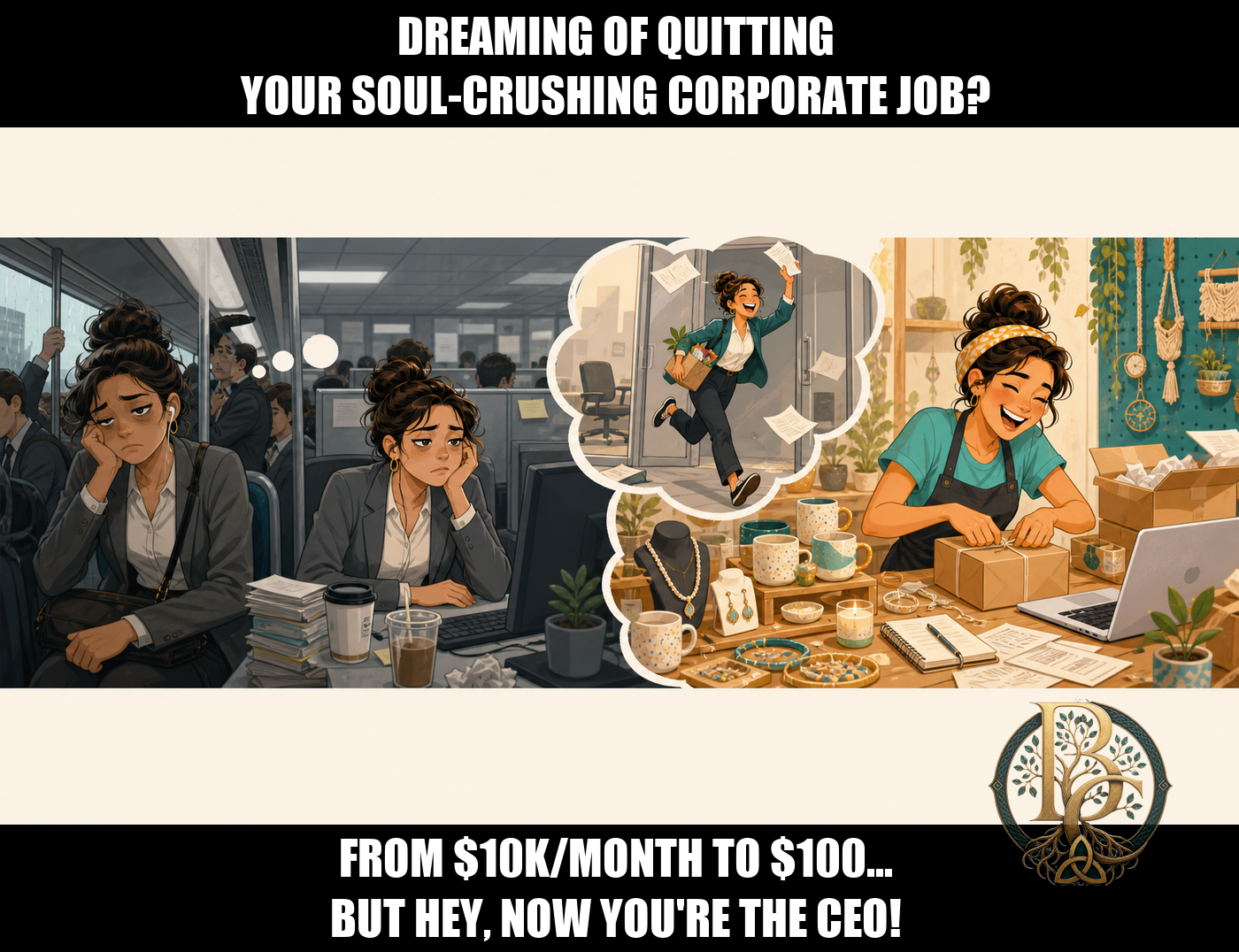
Sometimes the dream starts during a soul-crushing commute, under fluorescent lights, surrounded by toxic office gossip, personal politics, and glass ceilings, while you fantasize about the exact day you quit and how dramatic you might make it. That dream of freedom, flexibility, and building something of your own is valid. It is also why the budget matters, because the leap can feel very different once the first real numbers arrive.
Quick answer
What should be in a hobby business startup plan?
At minimum, a useful hobby business startup plan should cover what you sell, who buys it, what you legally need before selling, how you will market it, what your website or sales platform must do, and how much cash you need for launch plus the first few months.
How much should I budget before turning a hobby into a business?
First, budget beyond the obvious supplies. Include licenses, registrations, insurance, testing, packaging, website costs, marketing experiments, platform fees, taxes, professional help, and a cash cushion for delays or mistakes.
What costs surprise new hobby business owners?
Often, the surprise costs are compliance, renewals, software subscriptions, payment processing fees, shipping materials, ad testing, broken website features, and the unpaid time it takes to learn systems you did not expect to manage.
Can I start small without skipping the foundation?
Yes. You can start small by keeping your offer simple, limiting inventory, testing one sales channel, and using affordable tools. However, the essentials still need to be handled from the beginning: legal requirements, pricing, basic records, a trustworthy web presence, and a simple marketing plan.
Idea validation
Is my idea plausible? Will anyone want to buy it?
Well, do you use your product? Does it solve a problem in your life? Then yes, it is a plausible idea. That does not mean every version will sell, or that your first launch will be perfect. It means the idea is worth testing with the right plan.
How many times have you watched Shark Tank or The Lion’s Den and seen pitches where the investors liked the product, but declined to invest because the business plan, pricing, or finances were weak? The idea was not always the problem. The plan was.
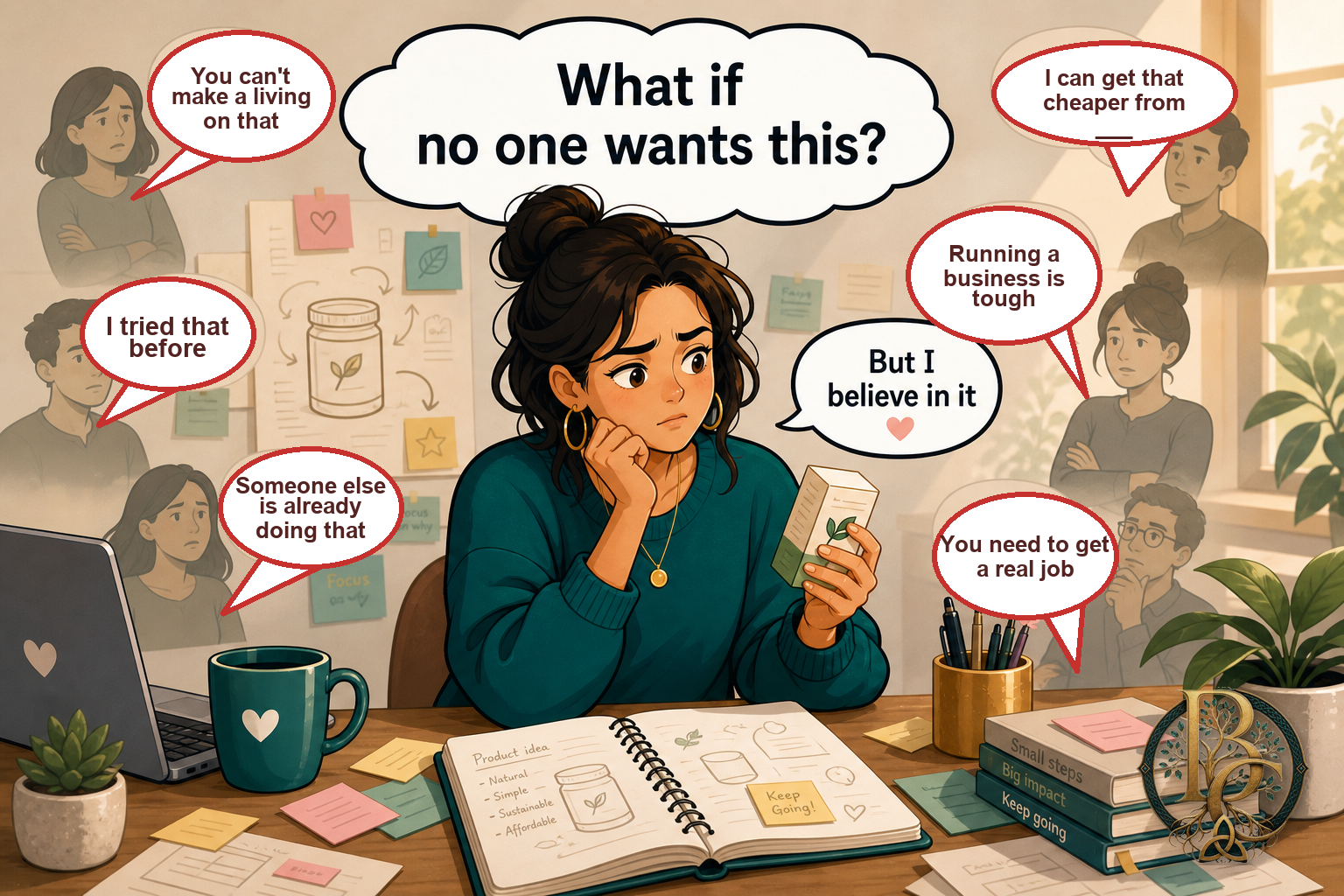
When I shared my Avo Nice Day microfarm, people knew this was just turning a hobby into a side hustle, and the response was very positive. But when I first announced my plans for Doggo Nice Day as a serious business and my next chapter on social media, some of the response was almost visceral. One friend commented, “I tried to do a dog treat business once and it didn’t work.” I swear, I could hear her eyes rolling as I read it.
In fairness, this friend had seen my e-commerce businesses in recent years: one that was a moderate success and one that was a complete flop. What she did not know was that I had learned through both of them. By the time I was ready to launch my dog bakery, I was completely prepared. I had my licenses, my SCORE mentor, my business plan, and my marketing plan.
While I knew about her previous attempt in this general space, I also knew my plan and product were completely different. Sometimes, your biggest critics are going to be the people closest to you.
That is why I recommend getting a SCORE mentor, so you can get unbiased, expert advice instead of building from fear, criticism, or cheerleading alone.
Lesson 1
All businesses come with layers of licensing, fees, and registrations
For example, before the dog bakery, there was my microfarm, and that is where I first learned how deep the hidden costs really go.
Running a microfarm required:
- Becoming a certified producer
- Securing an avocado exemption
- Going through inspections
Then I launched the dog bakery, and the same pattern repeated in a different form.
For the bakery, I needed:
- A business license
- A food manager certificate
- A pet food production license
And that pet food production license was not just paperwork. It required:
- Sending product samples to a lab for testing
- Creating compliant ingredient labels
- Submitting those results for approval
On top of that, I needed a food liability insurance policy.
Those costs do not stop after launch
This applies to every business, not just food-based ones. No matter what you are starting, you will need:
- Business registrations
- Tax registrations
- Permits specific to your industry
- Ongoing compliance requirements
And of course, there were still all the expected costs across both businesses:
- Ingredients and raw materials
- Packaging and labeling
- Displays, equipment, and market setup
To actually get in front of customers, I needed to pay vendor fees at markets and events. Some take a percentage of sales, around 10 percent. Others charge flat fees, sometimes up to $350 per day. That is before you have even sold a single item.
Then there are the everyday money-moving fees:
- Banking fees
- Card processing fees
- Bank transfer fees

Etsy can be a great market test, but the fees change the math fast
Etsy can be a smart place to start because people are already there searching for handmade, custom, vintage, and niche products. If you are testing whether strangers want what you make, that kind of built-in marketplace can be valuable.
However, Etsy is not the same thing as owning a sustainable sales system. You are building inside someone else's platform, under someone else's rules, with fees coming out of every order before you have paid for materials, packaging, labels, supplies, marketing, taxes, or your own time. Etsy and other marketplace platforms are for-profit businesses. They can give you a place to showcase and sell your work, but their pricing, policies, and fees are designed around their profits first, not yours.
What that looked like in the Irish-themed store
The Irish-themed store I talk about later in this article started with a novelty mug and grew into a boutique with custom-made clothing and housewares. One of the products was handmade leggings.
- Sale price$65.00
- Cost to make the leggings$30.00
- Shipping, Etsy fees, and selling costs$30.24
- What was left before paying myself$4.76
That $4.76 did not include the labor to design, make, photograph, list, package, message customers, or manage the order. The product sold, but the business model did not leave room for income.
Lesson 2
“Cheap” setup is usually expensive later
For example, I have seen it over and over, and yes, learned it myself: choosing the fastest, cheapest way to get something live. It works until it does not. DIY logos that do not scale. Templates that break the moment you need something custom.
However, there are budget-friendly options for almost everything, and that is not a bad thing. Most businesses have to start realistically. As your business grows, though, you will need to keep investing in upgrades that support that growth. The key is making sure the budget-friendly options you choose are still solid, scalable, and safe enough that they will not break your business later.
If you do not pay for quality upfront, you pay for fixing things later. And fixing always costs more.
Lesson 3
You still have to market, even when you are “out there”
Fortunately, I already had experience in marketing, so I was prepared for this. But I see many other vendors struggling with the same assumption: that being at a farmers market means built-in customers. It does not.
People do not automatically know:
- Your kind of product is at the market
- What you sell
- Why your product is different
- Why they should stop at your booth
However, foot traffic is not a marketing strategy.
If you struggle to explain why someone should stop, listen, or buy, start with your pitch. I wrote more about that in Every No Is a Script: How to Pitch Your Product Like a Pro.
So on top of everything else, I had to invest in:
- Social media content and consistency
- Promoting specific market days, times, and locations
- Paid ads to reach local audiences
- Branding that stands out in a crowded market
- Signage and visuals that stop people mid-walk
Social media also needs more than random posting. For a deeper look at that, read Small Businesses & Social Media: You're Doing It Wrong.
Lesson 4
Marketing costs more than you think because it takes testing
You can have the best product in the world, but if no one sees it, it does not matter.
You also have to understand your demographics. Who are your customers? What do they care about? How much time do they have? What can they afford right now?
In other words, plan for:
- Ad spend is not one-and-done. It is testing.
- Content takes time or money, usually both.
- SEO for small business is slow but essential.
As a result, absolutely everything can affect sales: weather, local events, politics, the stock market, gas prices, school schedules, holidays, and the general mood of your customers. Marketing is not just posting. It is paying attention to the real world your customers are living in.
Therefore, your budget should not just include marketing. It should include learning what works.
Lesson 5
I became a web developer by accident
My first e-commerce business actually started with a funny, slightly ridiculous origin story. After an inappropriate encounter where someone insulted me for being Irish, I got the idea for a novelty mug that turned the moment into a joke instead of letting it sit there.
That one cup became an online store. I started with the intention of selling novelty items, but the business soon evolved into a much more serious boutique with high-quality, custom-made clothing and housewares.
Selling through Etsy helped me test whether people wanted the products, but it also showed me how little control I had over the customer experience, the pricing, the fees, and the long-term relationship with my buyers.
The standalone site actually started because I was taking a digital marketing course. I built a website with a free theme for the course lessons, then kept the site and domain while I was selling on Etsy. Once I realized the marketplace could not be the whole business model, I needed to focus on my own website instead of treating it like a side experiment.
At first, everything looked fine. Then the problems started:
- Checkout issues
- Plugins conflicting
- Pages loading slowly
- Things breaking after updates
- Features that almost worked, but not quite
So I did what most business owners do. I hired developers to fix it. Except they did not fix it. They patched it.
Every issue became another workaround
Every issue became:
- A workaround instead of a solution
- Another plugin instead of proper development
- Another bill without real stability
The site became more fragile with every “fix.” At some point, it was easier to learn how to do it myself than to keep paying for temporary solutions.
So I did, but not halfway. I started taking courses, studying the foundations properly, and became accredited so I could actually understand what was happening under the hood, not just apply surface-level fixes.
Free resources
Free resources belong in your hobby business startup plan
For example, one resource I have personally used is SCORE, a nonprofit partner of the U.S. Small Business Administration that supports entrepreneurs and small business owners.
In addition, many cities also have free small business resources, newsletters, workshops, and local events designed to support people who are trying to start or grow a business. I attended a free resources fair from the City of Long Beach while I was building my bakery, and that is where I met my SCORE mentor. That connection became a tremendous help in every aspect of owning a business.
Beyond mentoring, SCORE offers workshops, events, recorded webinars, online courses, startup roadmap guidance, templates, and business resource hubs. They also have resources on funding, credit, financial management, and business planning, which can help you understand what kind of funding you may need before you start applying for anything.
If you are still in the idea stage, or if you already started but feel overwhelmed, it can be a smart place to get grounded before making expensive decisions. Their free newsletter is also worth signing up for if you want ongoing business tips, events, and resources delivered to your inbox.
Lesson 6
Your website is not a line item. It is your infrastructure.
After all, a website is not just, “I need something online.” It is:
- Your storefront
- Your first impression
- Your sales funnel
- Your operations hub
Your digital presence is often making the first impression before you ever speak to a customer. I wrote more about that in Your Digital Presence Is Interviewing for Your Business. Is It Getting Hired?.
Most startup budgets treat it like a checkbox.
What I did not account for initially:
- Proper development, not just design
- Mobile optimization that actually works
- Speed, which directly affects conversions
- ADA accessibility, because yes, this matters legally
- Security and backups
- Integrations for payments, email, and analytics
- Ongoing maintenance

Lesson 7
“But I use Shopify, Squarespace, or GoDaddy...”
I hear this all the time, and I get it because I have been there. Those platforms are great tools. But they are not complete solutions.
What shows up later:
- App and plugin fees
- Design limitations
- Workarounds for basic functionality
- SEO limitations
- Accessibility gaps
In other words, you are not avoiding costs. You are delaying and stacking them.
Lesson 8
Your business structure is part of your budget
One of the smartest decisions I made was setting up an LLC to protect everything I was building. But like everything else, that was not just a one-time task.
An LLC comes with:
- Formation costs
- Filing fees
- Annual reports or renewals, depending on your state
- Potential legal or accounting support
In my case, it is protecting multiple ventures under one umbrella. Your business structure is not just a legal decision. It is a financial one. It should absolutely be part of your startup and ongoing budget.
Lesson 9
Monthly costs belong in your hobby business startup plan
This one sneaks up on you.
- Email platforms
- Scheduling tools
- Design software
- Hosting upgrades
- Plugins and subscriptions
Individually, each one may feel manageable. Together, they become a real line item. As a result, recurring costs are just as important as upfront ones, and they are easier to overlook.
Lesson 10
Legal and compliance is not optional
This applies across every type of business.
Things I now always account for:
- Privacy policies
- Terms and conditions
- ADA accessibility
- Proper disclosures
Unfortunately, there are thousands of cases of small and even hobby businesses being hit with lawsuits over this.
Lesson 11
Time is a cost, even if you do not pay yourself yet
Every shortcut has a time cost:
- Learning platforms
- Troubleshooting issues
- Rebuilding things that were not done right
Meanwhile, time spent fixing problems is time not spent growing your business.
Lesson 12
You need a cushion because something will go wrong
It always does.
Illness, injuries, and health emergencies belong in that cushion too. Just as things were getting good, I had a health crisis and emergency surgery. My hospital stay was four days. The recovery was two months.
- A tool breaks
- An ad flops
- A platform changes
- Sales take longer than expected
- An illness, injury, or health emergency interrupts work
Ultimately, a startup budget without a buffer is not a plan. It is a gamble.
In California, independent contractors are not automatically covered by State Disability Insurance (SDI), but self-employed people and independent contractors who do not pay into SDI can apply for Disability Insurance Elective Coverage (DIEC). DIEC can provide Disability Insurance and Paid Family Leave benefits, but you generally need to be enrolled for at least six months before applying for benefits and must meet eligibility, income, and premium requirements. Check your state’s rules before you need them.
Lesson 13
Foundation matters more than appearance
This is the biggest mindset shift.
A lot of business owners focus on:
- “Does it look good?”
- “Can I launch quickly?”
The better questions are:
- “Will this scale?”
- “Is this secure?”
- “Is this compliant?”
- “Will this convert?”
In the long run, a beautiful business built on a weak foundation will cost you more than an average-looking one built correctly.
Conclusion
If this all sounds scary and overwhelming, it is.
Turning a hobby into a business is not just about doing something you love. It is about stepping into a world of responsibility, regulations, costs, and constant decision-making that most people do not see until they are already in it. From licensing and taxes to marketing and operations, it is a lot to take on.

But the leap of faith does not have to be blind.
When you understand what you are walking into, when you plan for the costs, learn the requirements, and build with intention, you give yourself a real chance to succeed. You move from guessing to building. From hoping to executing.
Is it worth it? Absolutely.
Am I rich? HAHAHA! No. I do make a profit and a living, but I have also had to make many lifestyle changes and budget cuts. I work harder and longer days than I ever did at any job, because I am now running Banba Creations, Doggo Nice Day, and Avo Nice Day. In the end, the dog bakery and the microfarm are still hobby businesses, not standalone incomes, while web development and marketing are my bread and butter.
But, every dog I make happy, every customer I make smile, every client that scores sales, every day is a victory that reminds me why I do this.
My mental health, personal happiness, satisfaction, and sense of self-worth are far better than they were when I was working in a corporate job, and that is priceless. My success is now measured by my actual products, my abilities, and the results I create, not personal politics or corporate bean counters.
With the right tools, knowledge, and foundation, what feels overwhelming now becomes something you can manage, and eventually, something you can grow.
And that is when your hobby stops being just something you enjoy and becomes something that truly works for you.
Copyright © 2026 Banba Creations LL Digital Media LLC. This article is provided for educational and informational purposes only and may not be copied, reproduced, republished, or distributed without prior written permission.
Web development and marketing strategy
Ready for a website and marketing plan that support the business you are actually building?
Banba Creations builds strategic, accessible, SEO-minded websites and marketing plans rooted in your audience, goals, and real-world sales conditions. Connect for a free consultation so we can look at where you are, what you need next, and how your website and marketing can work together. It may be the one “free” thing in business that will not break, need a plugin, and cost you more next month.